DEVELOPMENT OF SOFT SENSORS IN WATER DISTRIBUTION NETWORKS (DESW)
This project is supported by the “SUB1.1 Clusters of Research Excellence (CREs)” Action of the National Recovery and Resilience Plan “Greece 2.0”, co-funded by Greece and the European Union – NextGenerationEU, under the project “Development of Soft Sensors in Water Distribution Networks (ΥΠ3ΤΑ-0560428-DeSw)”.
Goal of the Project
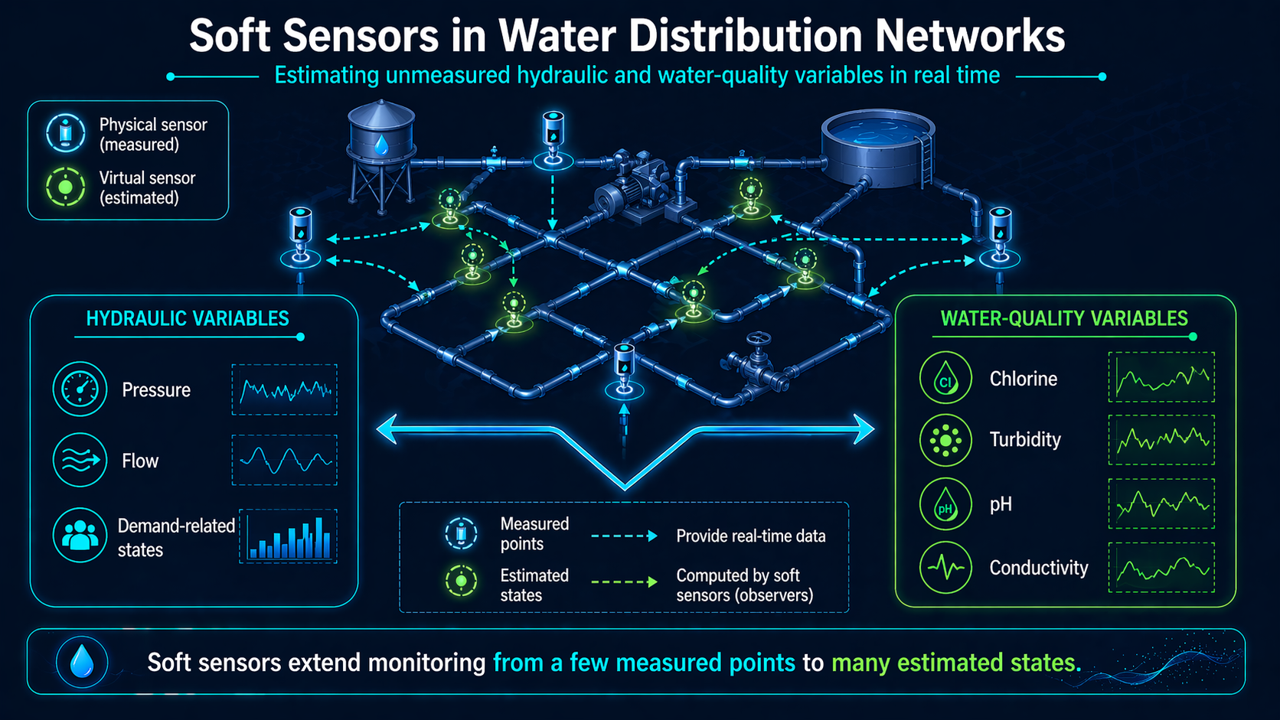
The goal of the project is the development of software tools for the realtime estimation of quality indices of the water in distribution networks. The key point is the development of software sensors (soft sensors). The results of the present research will contribute to the public health, being the main priority and imperative goal of Water Supply Agencies. In addition, the present research will provide tools that enhance the reliability and the overall performance of the network. In practice, the models of the water networks, or their parameters, are unknown or not accurately known. This characteristic obstructs the direct use of the models to estimate the variables being related to the quality of the water. Also, the use of black box models, being exclusively determined by machine learning algorithms, does guarantee the convergence of the estimations to the real values, particularly when tested using new data sets. in the present project, in order to circumvent these difficulties, a new approach based on grey models will be developed. The approach uses the method of designing soft sensors, through switching observers. This method is an achievement of the Robotics, Automatic Control and Cyber-Physical Systems Laboratory of the National and Kapodistrian University of Athens. The method, that covers multi model plants and nonlinear plants with unknown parameters, will facilitate the estimation of the variables expressing the quality of the water through the development of appropriate open-source software modules embedded in real time computer platforms. The first aim of the project is the extension of the method of soft sensors, with switching observers, to cover water distribution networks. The extension will be based on the development of appropriate data driven AI systems that will provide efficient estimations of the parameters of the network and consequently accurate estimations of the quality indices of the water, like chloramine, nitrates, etc. The estimations will be computed, using measured data of chlorine, pressure, temperature, and conductivity. The second aim of the project is the management of the soft sensors, through appropriate safety modular supervisors coordinating the soft sensor modules. The third aim is the development of open-source software implementing the supervisors and the soft sensors. This software will be integrated to Supervisory Control and Data Acquisition systems. The resulting algorithms will contribute to predictive maintenance of the components of the water network. This is the fourth aim of the project. It is important to mention that predictive maintenance contributes to the estimation of the non-measured variables, in the sense that it facilitates the preservation of the quantitative characteristics of the network.
Work Packages
The Work Packages of the project are:
Publications
D. G. Fragkoulis and F. N. Koumboulis, "Supervisor Water Level Control for the Tanks in a Modular Water Distribution Network Testbed," 2025 IEEE 29th International Conference on Intelligent Engineering Systems (INES), Palermo, Italy, 2025, pp. 000039-000044.
Abstract: A modular testbed representing water distribution networks is studied, by presenting the Discrete Event System parametric models of all actuators and sensors integrated in the testbed. The desired performance of the tanks in the testbed is expressed by a set of rules. The set of rules is translated to a set of appropriate parametric regular languages. The supervisors realizing the regular languages will be developed in a form satisfying nonblocking and Physical Realizability. Finally, the proposed supervisors are implemented in Structured Language for Programmable Logic Controllers and Supervisor Control and Data Acquisition systems using the CODESYS open platform.
D. G. Fragkoulis, F. N. Koumboulis, M. P. Tzamtzi, and N. D. Kouvakas, "Supervisor Control of a Cyber-Physical Water Distribution Network in the Presence of Actuator and Sensor Faults," 2nd Olympiad in Engineering Science, June 10-14, Stavanger, Norway, 2025.
Abstract: The models of the actuators (pumps, and valves) and water level sensors of a Water Distribution Network (WDN) testbed are presented, in the presence and the absence of faults, using Discrete Event System (DES) models in the Ramadge-Wonham framework. The cases of faults in the vertical valves, the pumps and the sensors are considered. In both the presence and the absence of faults, the desired behavior of the system is imposed in the form of rules with a parametric number of actuators and sensors. A hybrid supervisor control architecture will be designed based on the desired rules. The properties of the parametric controlled system are proved.
N. D. Kouvakas, F. N. Koumboulis, M. P. Tzamtzi, and D. G. Fragkoulis, "Toward the Design of Chlorine Soft Sensors via Stepwise Safe Switching Observers for a Primary Water Distribution Network," 2nd Olympiad in Engineering Science, June 10-14, Stavanger, Norway, 2025.
Abstract: In the present paper the problem of designing chlorine soft sensors via safe switching observers for primary water distribution networks (PWDNs) is investigated. The PWDN is modelled as a system of nonlinear hyperbolic partial differential equations (PDEs) describing fluid motion in the pipe network and a set of PDEs describing advection, dispersion and decay of chlorine in the pipes. The model of the network incorporates water demand from users. The overall model is approximated as a system of nonlinear ordinary differential equation. Based on the nonlinear approximation of the network, linear approximants, around prespecified operating points, are produced. Based on this set of operating points a bank of switching linear observers is developed toward estimation of chlorine concentration at specific points of interest. The observer parameters are determined via a metaheuristic algorithm. The design is completed through a data‐driven rule‐based system, performing stepwise switching between the observers of the bank, for the operating points determined previously. The efficiency of the proposed switching scheme is demonstrated through series of computational experiments, where it is observed that the proposed approach performs satisfactorily.
D. G. Fragkoulis, F. N. Koumboulis, A. N. Menexis, M. P. Tzamtzi, and N. D. Kouvakas, "Design and FIWARE Implementation of a Pump Fault Modular Diagnosis System in Water Distribution Networks," 3rd International Conference on Frontiers of Artificial Intelligence, Ethics, and Multidisciplinary Applications, September 18-19, Stavanger, Norway, 2025.
Abstract: A class of Water Distribution Networks (WDNs), based on a Testbed, is studied. The Discrete Event System (DES) models of the valves, the pumps and water level sensors of this class are presented. Possible pump stuck faults have been included in the DES models of the pumps. A supervisor is designed, that restricts activation of the pump when the valve is closed. The model of the water level sensor is developed to be parametric with respect to the number of level zones. A modular Diagnoser System is designed to detect pump faults. An individual diagnoser in DES form is proposed for every pump and each zone of the water level sensor. The proposed Diagnoser System is implemented to the open platform FIWARE. Smart data models with all corresponding data les are presented.
N. D. Kouvakas, F. N. Koumboulis, M. P. Tzamtzi, and D. G. Fragkoulis, "Soft Sensor Design for Water Distribution Networks using Unknown Input Safe Switching Observers," 3rd International Conference on Frontiers of Artificial Intelligence, Ethics, and Multidisciplinary Applications, September 18-19, Stavanger, Norway, 2025.
Abstract: In this paper the problem of designing soft sensors for non-measurable flow variables in water distribution networks is considered. A linear unknown input observer, with specific type pole placement requirements as well as transient response requirements, is developed based on the nonlinear dynamics of a benchmark water distribution network. The network model considers both measurable and non-measurable disturbances. To handle the inherent nonlinearities of the system, linear approximants of the nonlinear model around pre-selected nominal points are developed. These approximants are used to design a switching observer bank, where each observer is tuned to operate satisfactorily in its corresponding operating area. The observer parameters are optimally set using a metaheuristic optimization algorithm that improves the quality of estimation and the characteristics of the observer free response. Finally, a data-driven rule-based switching technique is utilized to switch among the best suited observer according to the current system conditions.
D. G. Fragkoulis, F. N. Koumboulis, M. P. Tzamtzi, and N. D. Kouvakas, "Supervisor Control and Pump Fault Diagnosis through Flow and Pressure Sensors in a Water Transfer Network," 2025 10th South-East Europe Design Automation, Computer Engineering, Computer Networks and Social Media Conference (SEEDA-CECNSM), Patra, Greece, 2025.
Abstract: In the present paper, a Water Transport Network (WTN) is studied. The analytic models of the devices of the network are presented in Discrete Event Systems (DES) form. Reduced models of sensors are developed to facilitate control and diagnosis. Toward satisfactory water level and water quality in the reservoir tank of the WTN, two functionality rules are formed. A distributed supervisor control architecture is proposed to realize the functionality rules. A fault diagnosis system will be designed for the diagnosis of faults of the pump of the WTN. Finally, implementation aspects of the designed supervisors and the diagnosis system in Structured Text Language for Programmable Logic Controllers are resolved.
M. P. Tzamtzi, F. N. Koumboulis, D. G. Fragkoulis, and N. D. Kouvakas, "Toward the Development of an Ontology for Supervisory Control and Fault Diagnosis in Water Distribution Networks," 2025 10th South-East Europe Design Automation, Computer Engineering, Computer Networks and Social Media Conference (SEEDA-CECNSM), Patra, Greece, 2025.
Abstract: In this paper, the development of an ontology for supervisor control and fault diagnosis in water distribution networks (WDNs) is investigated. The components of the WDN, the Supervisors and the Diagnosers are modelled in the Discrete Event System (DES) framework. The main goal of the paper is the introduction of the required ontological concepts. The entities, concepts, properties, relations and processes, that are required in order to represent the DES models of WDN devices, supervisors and diagnosers are presented in a Basic Foundation Ontology formalism. Finally, the ontology is extended to include rules being fundamental for supervisor and diagnoser design. These rules are selected so as to refer to groups of interconnected WDN devices. This way modularity is supported and various WDN architectures are covered.
N. D. Kouvakas, F. N. Koumboulis, M. P. Tzamtzi, D. G. Fragkoulis, K. K. Katsiavrias, K. Katsiavrias, and J. Dimitropoulos, "On the Discrete Time Stepwise Safe Switching Soft Sensor Design for Water Distribution Networks," 12th International Conference on Control Engineering & Information Technology, Istanbul, Turkey, 2026.
Abstract: A discrete-time, model-based soft sensor is developed to estimate free chlorine concentration in selected sections of a water distribution network (WDN). The study considers a benchmark network with a star-like geometry, which is initially described by a set of nonlinear ordinary differential equations. The hydraulic subsystem is approximated in a quasi-static form, such that steady-state flows is consistent with boundary heads and demand withdrawals that drive the chlorine transport–reaction dynamics. Around a set of preselected operating points, linear approximants are obtained and the respective exact discrete-time state-space representations are derived under zero-order-hold interpolations. Based on this model, a bank of full-order Luenberger-type discrete-time observers is constructed, constituting base of the the proposed soft sensor. The observer gains are determined through a multicriterion design procedure that combines discrete-time pole-location requirements with a norm-based minimization objective. Simulation results on the benchmark network indicate high-fidelity chlorine estimation, with deviations limited to brief intervals during operating transitions.
N. D. Kouvakas, F. N. Koumboulis, M. P. Tzamtzi, D. G. Fragkoulis, K. K. Katsiavrias, K. Katsiavrias, and J. Dimitropoulos, "Composite water quality indices for supply networks," 12th International Conference on Control Engineering & Information Technology, Istanbul, Turkey, 2026.
Abstract: This paper presents a comprehensive framework for the assessment and operational monitoring of water quality in water supply networks, as well as representative application based on data from the SCADA system of the water supply system of Lamia, Greece. Compliance requirements, based on European and international regulations and guidelines, are summarized for the most critical water quality indices. Distinction between single-parameter water metrics and composite water quality indices is summarized. Indicative composite quality indices suitable for real time applications to several stations of Lamia’s water supply network are suggested. Real time monitoring of composite quality indices is proposed to be used as a tool for summary quality assessment and as a basis for early event detection and decision support.
F. N. Koumboulis, N. D. Kouvakas, M. P. Tzamtzi, D. G. Fragkoulis, A. N. Menexis, K. K. Katsiavrias, K. Katsiavrias, and J. Dimitropoulos, "Toward Edge Implementation of Soft Sensors for Water Distribution Networks," 12th International Conference on Control Engineering & Information Technology, Istanbul, Turkey, 2026.
Abstract: This paper presents an edge-oriented implementation of a discrete-time bank of switching observers for chlorine estimation in a benchmark water distribution network (WDN). The approach combines local execution of multiple observers within a Node-RED runtime, deterministic data acquisition from a programmable logic controller via Modbus Transmission Control Protocol, and cloud-supervised switching. The architecture enables parallel observer execution, telemetry arbitration across a single stream, and continuous adaptation of the runtime. The experimental validation is carried out in a hardware-in-the-loop setup in which a hydraulic and quality simulated model provides the measurement data for a physical PLC in real-time, allowing to assess the entire edge–cloud pipeline under realistic conditions of an industrial communication system.
N. D. Kouvakas, F. N. Koumboulis, M. P. Tzamtzi, D. G. Fragkoulis, K. K. Katsiavrias, and K. Katsiavrias, "Α Circuit Model of WDNs Toward Low Power Chlorine Soft Sensor Implementation," 2026 Panhellenic Conference on Electronics & Telecommunications (PACET), Patras, Greece, 2026.
Abstract: In this paper a modular electrical equivalent of a benchmark primary water distribution network to support circuit-level co-simulation and potential embedded realization of real-time soft sensing is proposed. The hydraulic dynamics are mapped to an analog circuit via the electrohydraulic analogy, while chlorine transport and decay are represented by a cascaded concentration circuit driven by the volumetric flows, yielding a nonlinear ordinary-differential-equation model and corresponding linear approximants around selected operating points. Based on the linear approximants, a bank of full-order Luenberger observers is designed to estimate hydraulic and chlorine states under sparse measurements, and a stepwise safe transition rule is employed to maintain accuracy during operating-point changes.
F. N. Koumboulis, D. G. Fragkoulis, M. P. Tzamtzi and N. D. Kouvakas, "Supervisor Control of Water Distribution Network Actuators under Partial Observation," 1st International Conference on Monitoring and Control of Water Systems, Chalkida, Greece, 2026.
Abstract: The present paper proposes an observer for Water Distribution Networks actuators, in order to address the synchronization problem between local and central control stations, caused by communication interruptions. The observer is developed using actuator signals received after communication is restored. The goal of the observer is to resynchronize the actual operating mode of each actuator with the monitored mode of the central control station.
N. D. Kouvakas, F. N. Koumboulis, M. P. Tzamtzi and D. G. Fragkoulis, "Discrete Time Soft Sensor Design for Water Distribution Networks via Metaheuristic Parameter Optimization," 1st International Conference on Monitoring and Control of Water Systems, Chalkida, Greece, 2026.
Abstract: The present paper deals with the discrete-time soft sensor design problem for estimating chlorine concentration in water distribution networks using a limited number of available measurements. The nonlinear dynamic model of a benchmark water distribution network (WDN) is linearly approximated around selected operating points, and a bank of full-order Luenberger-type observers is designed in discrete time. The observer gain matrices are determined through a metaheuristic parameter optimization procedure, combined with robust pole placement considerations, while spheroidal target operating areas are used to support safe switching among observers during transitions. The performance of the proposed scheme is illustrated through computational experiments.
M. P. Tzamtzi, F. N. Koumboulis, N. D. Kouvakas, and D. G. Fragkoulis, "DES Supervisor realization of the Safe Switching Mechanism of Soft-Sensors," 1st International Conference on Monitoring and Control of Water Systems, Chalkida, Greece, 2026.
Abstract: A supervisory scheme is proposed, toward the Discrete Event Systems (DES) realization of the safe switching architecture for a bank of observers composing soft sensors for water distribution networks (WDNs). The bank of observers combined with the switching mechanism are used to cope with the nonlinear characteristics of the hydraulic and water quality variables’ dynamics in WDNs. The switching mechanism among the observers of the bank, as well as the proposed supervisor for safe switching are represented in DES form. This way, a hybrid soft sensor system, including a continuous time subsystem and a DES subsystem, is proposed.
M. Skarpetis, F. N. Koumboulis, N. D. Kouvakas and M. P. Tzamtzi, "An Integrated MATLAB Graphical User Interface for Hydraulic and Water Quality Modelling and Analysis in Water Distribution Networks," 1st International Conference on Monitoring and Control of Water Systems, Chalkida, Greece, 2026.
Abstract: In this paper a MATLAB-based Graphical User Interface is designed for the sophisticated modeling and hydraulic and quality analysis of water distribution networks. By the integration of various computational modules the interface allows the construction of complex water networks providing information about nodes, pipes, Hydraulic tanks and heads while produce Static and Transient Hydraulic analyses as well as Multi-Species Water Quality assessments. The framework utilizes mathematical algorithms such as the Global Gradient Algorithm, the Method of Lines for pressure wave analysis etc. The results are compared with the respective results of EPANET. The proposed tool serves as a bridge for theoretical – practical validation and it is very helpful for monitoring and for developing software-sensor-oriented capabilities for Water Distribution Networks.
T.-Ch. Drosou, N. D. Kouvakas, F. N. Koumboulis, M. P. Tzamtzi, D. G. Fragkoulis and G. Chamilothoris, "Performance Quantitative Assessment of Linear and Discrete Time Approximants for Dynamic Water Distribution Network Models," 1st International Conference on Monitoring and Control of Water Systems, Chalkida, Greece, 2026.
Abstract: Water distribution networks (WDNs) exhibit nonlinear hydraulic dynamics due to pipe friction, fluid inertia, and water compressibility. This paper evaluates the accuracy of linear and discrete time approximants of a benchmark nonlinear WDN, modelled using the Elastic Water Column (EWC) approach. For this benchmark, three types of approximants are used: a linear continuous-time model, a nonlinear discrete-time model, and a linear discrete-time model. These approximants are compared with the original nonlinear continuous-time model, using the following criteria: the Integral Absolute Error (IAE), the Integral Square Error (ISE), the Integral Time Absolute Error (ITAE), the Integral Time Square Error (ITSE), and the Infinity Norm Error (INE).
F. N. Koumboulis, M. P. Tzamtzi, N. D. Kouvakas, D. G. Fragkoulis, K. S. Katsiavrias and K. K. Katsiavrias, "A Decision Support System Architecture for Quality in Water Distribution Networks," 1st International Conference on Monitoring and Control of Water Systems, Chalkida, Greece, 2026.
Abstract: A Decision Support Systems (DSS) is proposed to enhance operational efficiency for Water Distribution Networks, through embedment of Intelligent Software Agents, based on the following design approaches: Soft Sensor Agents, Supervisor Agents, Diagnoser Agents and Operator Agent. The Intelligent Agents aim to support dense monitoring, operational efficiency and water quality preservation. They are integrated into Supervisory Control and Data Acquisition systems, through an edge-cloud architecture.
M. P. Tzamtzi, F. N. Koumboulis, D. G. Fragkoulis and N. D. Kouvakas, "A generic supervisor control and fault diagnosis scheme for water quality and safe performance of water distribution networks", IEEE Access, 2026.
Abstract: The results of the present work have a threefold contribution. First, parametric modeling, in Discrete Event Systems (DES) form in the Ramadge-Wonham framework, of a generic Water Distribution Network (WDN) architecture is introduced, based on a corresponding WDN ontology. Second, a modular and distributed supervisor control scheme for WDNs is designed. The proposed supervisors aim to impose rules for efficient hydraulic operation and coordination between local and central control stations, as well as for equipment protection and water quality requirements. Third, modular and distributed diagnosers that aim to detect and identify incidents of equipment malfunction, pipeline rupture and water quality deterioration, have been developed. Water quality control and fault diagnosis take into account directives for the required values of water quality indices. The proposed modeling, control and diagnosis schemes handle observable and unobservable faults, as well as potential loss of communication between local and central control stations. Finally, the inherent flexibility of the present approach covers the majority of WDNs’ configurations, regardless of their size or complexity.
D. G. Fragkoulis, F. N. Koumboulis, M. P. Tzamtzi, N. D. Kouvakas, K. S. Katsiavrias, K. K. Katsiavrias, “Discrete Event Modelling, Supervisor Control and Fault Diagnosis of the Chlorinated Water Station of Delfino based on the Sensor and Actuator Interaction,” Journal of Sensor and Actuator Networks, vol. 15(4), p. 50, 2026.
Abstract: A chlorinated water station in Delfino, Greece, was studied from the control and fault diagnosis point of view, using the interaction of the devices installed to the station as well as rules resulting from the physical characteristics of the station. The DES models of the station’s devices (pumps, level sensors, flow sensors, and pressure sensors) are presented. The models of the pumps include both the activation/deactivation functionality and the regulation of the output flow of the pump. The models of the devices were validated using field data extracted from the monitoring system of the station. Towards protecting the pump from dry running and the tanks from overflow, a set of safety requirements were realized in the form of supervisor automata. Using field data, the effect of the supervisors in the activation/deactivation of the pumps was tested. A modular fault diagnosis system, where the number of fault diagnosers is equal to the number of pumps, was implemented to diagnose the faulty case of pump having stuck open despite deactivation command. A fault diagnosis system for a flow sensor of the station was developed and tested using the field data of the sensors and the pumping system. Supervisors and diagnosers were tested using one-week field data. The structured language code for PLC implementation of the diagnosers is presented.
N. D. Kouvakas, F. N. Koumboulis, A. N. Menexis, D. G. Fragkoulis, and M. P. Tzamtzi, “On Reduced Observer-Bank Synthesis and Edge Implementation for Residual Chlorine Concentration Soft Sensors in Water Distribution Networks,” Water, vol. 18 (1), p. 1924, 2026.
Abstract: In the present paper, a reduced observer-bank synthesis and edge-oriented implementation framework for a model-based residual chlorine concentration soft sensor in water distribution networks is presented. For a benchmark network described through nonlinear hydraulic and chlorine transport–reaction dynamics, local discrete-time linear approximants are derived around admissible operating points. Based on these approximants, a finite bank of full-order Luenberger-type observers is designed for the estimation of nonmeasurable chlorine concentration variables. The observer parameters are selected through a metaheuristic multicriterion tuning procedure that combines discrete-time poleplacement requirements with estimation-performance objectives. A central contribution of the paper is an observer-bank construction algorithm that eliminates redundant target operating areas. The algorithm adaptively covers the normalized input domain by generating each observer operating area after nonlinear steady-state computation, local linearization, observer tuning, and validation for each operating point. The resulting observer bank is combined with a switching supervisor based on target-area overlap and measurable-output convergence. The resulting scheme is implemented in a Node-RED edge runtime, where multiple observers execute in parallel and the supervisor/switching mechanism selects the active observer that provides the appropriate estimate. Deterministic telemetry generated by a MATLAB R2025b simulation of the water distribution network is fed to the Node-RED instance, enabling repeatable evaluation of acquisition, estimation, switching, single-stream telemetry arbitration, and runtime adaptation. Computational and edge runtime experiments demonstrate the feasibility of deploying the proposed switching-observer soft sensor for real-time chlorine monitoring in water distribution networks.M. P. Tzamtzi, D. G. Fragkoulis, F. N. Koumboulis, A. N. Menexis, N. D. Kouvakas, and K. K. Katsiavrias, “Distributed Supervisor Control for Pyrgos Water Station in the Presence of Pump Faults,” Springer 4th International Conference on Frontiers of Artificial Intelligence, Ethics, and Multidisciplinary Applications, September 9-11, L'Aquila, Italy, 2026.
Abstract: The water station of Pyrgos in Lamia, Greece, is controlled, using Discrete Event System (DES) modeling of all sensors and pumps of the station that incorporates a pair of pumps, that feed the first tank with water from a drilling source, as well as a third pump that concurrently feeds with water two tanks covering water demand in the housing estate of Pyrgos. A DES pump model that incorporates four types of pump faults, namely thermal overload relay, power relay failure, dry running condition and phase imbalance, is proposed. Next, a composite conjunction and disjunction supervisor architecture is proposed to coordinate the pumps, toward safe and effcient performance, in the presence of pump faults. The PLC implementation of the supervisory scheme is of decentralized and distributed architecture. Finally, the results are successfully tested and validated using field data from Pyrgos water station.
Partners
Robotics, Automatic Control and Cyber-Physical Systems Laboratory, Department of Digital Industry Technologies, National and Kapodistrian University of Athens
AKATT S.A.
